Results
This section outlines the concrete results we achieved up to important milestones. We structure it this way to make it clear that future extensions and optimizations to the protocol may shift these results in either direction, and we’re simply reporting on the current state of Gummiworm.
April 2026 Demo
Costs
Opening a new head costs 0.19 ADA . Each deposit costs the user 0.18 ADA . Each new major version (absorbing a deposit or remitting payments) costs a base of 0.18 ADA .
Timing
To decide on a deposit timeline for Cardano, we model the risk that a given block depth will be rolled back as an exponential decay curve:
Where is the block depth, is a normalizing constant close to 1, and is a decay rate derived from the Ouroboros security parameters. Using Cardano’s active slot coefficient () and the assumption that an adversary controls no more than a small fraction of stake, is approximately 0.04 per block, meaning the probability of a rollback halves roughly every 17 blocks.
Under this model, even a pessimistic estimate puts the probability of a rollback at depth 360 (approximately 2 hours at Cardano’s 20-second slot time) well below . At this depth, the expected loss is under $10 even for deposits as large as $5M USD, which justifies a flat 2-hour maturity wait for all deposits regardless of size. For users who need faster access to funds, the accelerated deposits feature allows them to source liquidity already inside the head at a market-determined price, bypassing the maturity wait entirely.
We complement this probabilistic model with circuit breakers: if the head observes competing chain forks diverging beyond a minimum depth across different peers (for example, due to a consensus bug in the Cardano node, as occurred in 2025 ), all deposit absorptions are halted until the fork resolves.
Soft confirmation of L2 transactions is limited by how quickly we can receive the order, process it with the Sugar Rush ledger, and persist the confirmation. In practice, on a machine provisioned for production workloads, with a single head peer and using JSON as a transport protocol, this is around 370 microseconds over network latency. We expect this to increase slightly with more head peers, and drop when we switch to binary transport protocols.
Hard confirmation latency depends on coil peer count and network conditions, which we will benchmark as the coil is deployed.
Throughput
In informal performance testing, we have observed peak throughputs around 4,000 TPS with the current single-peer head, and a sustained average of 3,400 TPS.
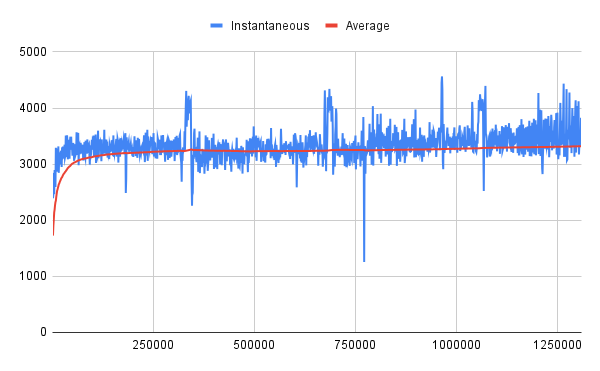
We believe there is significant headroom. In isolated benchmarks, the Sugar Rush CLOB ledger itself sustains over 70,000 TPS, indicating that the bottleneck lies in the surrounding infrastructure rather than in order matching and state transitions. Our current transport layer uses verbose JSON serialization, which we believe accounts for most of the gap. Switching to a binary protocol, batching incoming requests at the ingestion layer, and pipelining order execution should comfortably push end-to-end throughput above 20,000 TPS.